
List of Conjunctions in English | Learn to Use Conjunction Words
Home » Words List » List of Conjunctions in English | Learn to Use Conjunction Words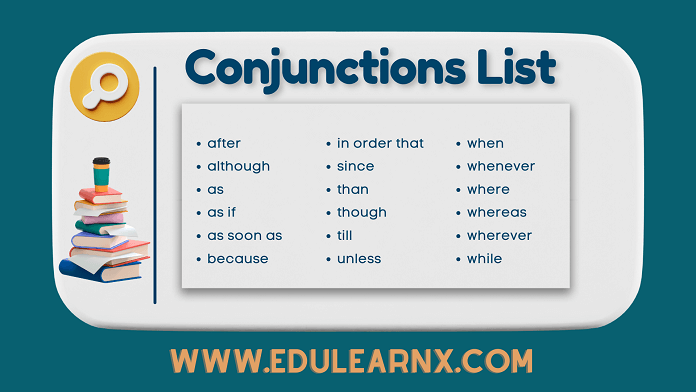
Are you searching for an ultimate list of conjunctions and conjunction words in English? Well, don’t worry; you’re on the right platform! You will find an easy way to learn joining words, conjunctions list, and types of joining words in the English language.
Learning English language would be different without conjunctions because it brings complex thoughts together. Writers or common people use conjunctions in their verbal and written communications daily. Are you ready to start expanding your vocabulary? Let’s continue reading an ultimate conjunctions list in English!
Conjunction Words (with Example)
What is a Conjunction Word?
A conjunction is a part of speech that links a sentence’s words, phrases, or clauses, facilitating coordination and revealing relationships between elements. They serve an essential function in a sentence and are also known as joining words.
Mixing up how you write complex sentences helps make your writing more interesting. If you only stick to simple sentences, your writing might miss out on expressing things more clearly and excitingly.
Simple Sentence Examples:
- She likes chocolate ice cream.
- Birds sing in the morning.
- The cat sleeps on the windowsill.
- He reads a book every night.
- It rains in April.
When you include complex sentences alongside simple sentences, it makes stronger prose.
Conjunctions are divided into three subgroups: correlative conjunctions, subordinating conjunctions, and coordinating conjunctions. Each subgroup is different and follows its own rules.
Examples of Conjunction Words:
Coordinating Conjunctions:
- She likes coffee and tea.
- He is tired, but he keeps working.
- You can have cake or ice cream.
Subordinating Conjunctions:
- I will go to the store if it stops raining.
- She succeeded because she worked hard.
- We’ll eat dinner before we watch a movie.
Correlative Conjunctions:
- You can either study for the exam, or you can go out.
- Both the cat and the dog were adopted.
- Julia is not only creative but also innovative.
More Examples:
- I enjoy hiking and camping.
This example uses the conjunction “and” to join two activities the speaker enjoys.
- She bought a new dress, but it didn’t fit well.
In this case, the conjunction “but” connects two independent clauses, expressing a dependent clause in the outcome.
- You can choose between pizza or pasta.
Here, the conjunction “or” presents a choice between two options.
- Students stayed indoors because it was raining heavily.
The conjunction “because” links the reason (rain) to the action (staying indoors).
List of Conjunctions | Types of Conjunctions

Coordinating Conjunction Words: FANBOYS
Learning the words on a coordinating conjunction list is both easy and enjoyable. The acronym FANBOYS simplifies this list, representing the seven essential words: for, and, nor, but, or, yet, and so. Memorizing this acronym facilitates quick recall of these crucial words.
Why Remember FANBOYS?
Discover the significance of these seven words, as they play a substantial role in both spoken and written English. With their brevity, each being less than four letters, and frequent usage. They serve to connect independent clauses, unifying them into cohesive sentences.
Coordinating Conjunctions List:
In English, seven types of coordinating conjunctions are known as FANBOYS to help you remember them.
- F – for: Similar meaning to “because” in a sentence.
- A – and: Joins ideas together.
- N – nor: Connects two negatives within a sentence.
- B – but: Connects contrasting ideas.
- O – or: Presents a choice between alternatives.
- Y – yet: Similar to “but,” emphasizing contrast.
- S – so: Indicates a result or consequence.
Using Coordinating Conjunctions:
Learn how to incorporate these conjunctions into your writing:
- For: Similar to “because” in providing reasons.
- But: Connects opposing ideas.
- Yet: Emphasizes contrast even more than “but.”
- Nor: Joins two negatives that the subject does NOT have or obtain.
- So/Yet: Suggests time and continuation depending on the context.
Committing FANBOYS to memory brings you closer to mastering your main conjunctions list.
How to Use Coordinating Conjunctions in a Sentence?
- She loves reading, but he prefers watching movies (Connecting Independent Clauses).
- I like both chocolate and vanilla ice cream (Combining Similar Elements).
- The weather was hot, yet they decided to hike (Expressing Relationships).
- She bought apples, oranges, and bananas at the grocery store (Joining Items in a List).
- You can have pizza or pasta for dinner (Showing Alternatives).
- He worked hard, so he earned a promotion (Expressing Cause and Effect).
Correlative Conjunction Words
Correlative conjunctions work in pairs, with each word of the pair positioned in distinct areas of the sentence. To ensure proper functionality, both terms must be introduced in the sentence.
These word pairs link equivalent sentence elements. For example, when “both” is followed by a noun, “and” should also be followed by a noun, contributing to sentence structure.
Correlative Conjunctions List
Below, we compile some correlative pairs you can use to structure your sentences.
| Correlative Conjunction | Corresponding Pair |
|---|---|
| Both…and | Not only…but also |
| Either…or | Neither…nor |
| Whether…or | Just as…so |
| Whether…or | As…as |
| As much…as | No sooner…than |
| Scarcely…when | Hardly…when |
| The more…the more | The less…the less |
| The more…the less | The more…the less |
| Not…but | Rather…than |
| Not only…but also | Such…that |
How We Use Correlating Conjunctions
Correlative conjunctions are pairs of words that connect similar structures or elements within a sentence. Here’s how to use them:
Both…and:
- She is both intelligent and hardworking.
Either…or:
- Julia can either go to the party or stay home.
Neither…nor:
- Neither the professor nor the students were happy with the result.
Not only…but also:
- Not only did he complete the project, but he also exceeded expectations.
Whether…or:
- I am undecided about whether to take a vacation or attend the conference.
Just as…so:
- Just as the light went, the room temperature was dropped.
As…as:
- She is as talented as her sister.
As much…as:
- Julia love you as much as I love chocolate.
No sooner…than:
- No sooner did he leave than the rain started.
Hardly…when:
- Hardly had I finished my meal when the phone rang.
The more…the more:
- The more Julia practices, the better you become.
The less…the less:
- The less you procrastinate, the more you accomplish.
Not…but:
- He is not a chef but a musician.
Rather…than:
- She chooses to walk rather than take a taxi.
Not only…but (also):
- Not only did she visit the museum, but she also explored the nearby park.
Such…that:
- It was such a beautiful day that we decided to have a picnic.
Subordinating Conjunction Words
Subordinating conjunctions connect dependent clauses to independent clauses. While a dependent clause cannot stand alone as a complete sentence, an independent clause can function independently. Consequently, dependent clauses provide supplementary information to a sentence.
These conjunctions establish a link between two clauses, allowing for expressions of cause and effect or the introduction of contrasting ideas. For instance, “because” signifies a cause-and-effect relationship, while “although” and “though” introduce contrasting concepts.
Despite common teaching advice that discourages starting sentences with words like “because” to prevent incomplete sentences, subordinating conjunctions like “because” can effectively initiate a sentence. This practice can enhance sentence structure and convey complex relationships between ideas.
Subordinating Conjunctions List
We compiled many subordinating conjunctions lists that exist.
| After | Although | As |
|---|---|---|
| As if | As long as | As much as |
| As soon as | As far as | As though |
| By the time | In as much as | Inasmuch |
| In order to | In order that | In case |
| Lest | Though | Now that |
| Now since | Now when | Now |
| Even if | Even though | Provided |
| Provide that | If | If then |
| If when | If only | Just as |
| Where | Wherever | Whereas |
| Where if | Whether | Since |
| Because | Whose | Whoever |
| Unless | While | Before |
| Why | So that | Until |
| How | Since | Than |
| Till | Whenever | Supposing |
| When | Or not | What |
How to Use Subordinating Conjunctions
Cause and Effect:
- Since the weather was favorable, we decided to picnic in the park.
Contrast:
- Although it was raining, they went for a walk in the woods.
Purpose:
- To succeed, you must work hard and stay focused on your goals.
Time Sequence:
- Before you leave for the airport, make sure you have all your documents in order.
Condition:
- If it rains tomorrow, the outdoor event will be moved indoors.
Comparison:
- She is taller than her younger brother, although they are only one year apart.
Concession:
- Even though he missed the train, he managed to arrive on time by taking a later one.
100 Examples of Conjunctions
Coordinating Conjunctions List Examples:
and: I like tea and coffee.
but: He is smart, but lazy.
or: You can have tea or coffee.
so: It’s raining, so we’ll stay indoors.
yet: She is quiet, yet confident.
nor: He neither sings nor dances.
for: I studied hard, for I wanted to succeed.
Subordinating Conjunctions List Examples:
after: We’ll go out after the rain stops.
although: It’s hot, although it’s still spring.
as: She smiled as she read the letter.
because: We stayed inside because of the storm.
before: Finish your homework before you play.
if: Bring an umbrella if it rains.
once: Once you finish, submit the report.
since: She’s been here since morning.
that: I heard that you got a promotion.
though: It’s cold, though it’s sunny.
till: Wait here till I come back.
unless: You can’t go out, unless you finish your chores.
while: Read a book while waiting.
where: I’ll meet you where the fountain is.
Other Subordinating Conjunctions List:
| Subordinating Conjunction |
|---|
| because of |
| in order that |
| even though |
| as long as |
| as soon as |
| just as |
| so that |
| in case |
| now that |
| as if |
| provided that |
| whereas |
| inasmuch as |
| whenever |
| until |
| whiles |
| by the time |
| even if |
| on condition that |
| so long as |
| apart from that |
| even when |
| if then |
| in as much as |
| in spite of the fact that |
| in the same way that |
| not only but also |
| notwithstanding |
| presuming that |
| rather |
| seeing that |
| unless and until |
| whereas as |
| whether or no |
| as against |
| as well as |
| in accordance with |
| in addition to |
| in relation to |
| in the light of |
| not to speak of |
| regardless of the fact that |
| so as to |
| with regard to |
 Hobbies That Start With E | Fun Hobbies Word List
 Hobbies That Start With D | Fun Hobbies Word List
 Hobbies That Start With C | Fun Hobbies Word List