
How Do Edtech Companies Get Found in AI Search? What 2,000 Education Websites Show
Home » Education » How Do Edtech Companies Get Found in AI Search? What 2,000 Education Websites Show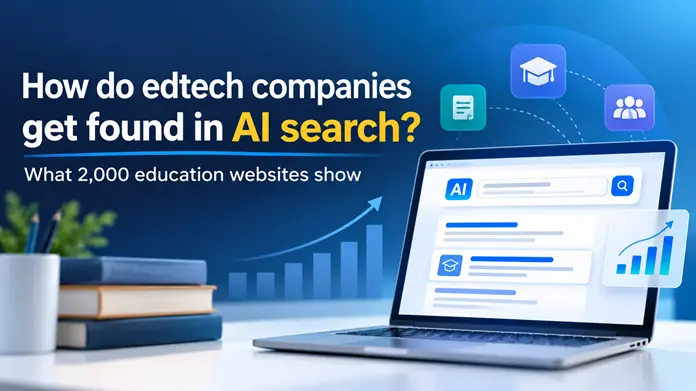
Picture a district IT director with a budget for a new learning platform. A few years ago, she’d have typed “best LMS for K-12” into Google, opened ten tabs, and started reading vendor sites. Now? She’ll likely read the AI summary at the top of the page, ask ChatGPT a follow-up or two, and have a shortlist before she ever lands on your site.
That shift is why I spent a good part of this year looking at how education companies show up online. Our study of close to 2,000 education company websites also coded around 1,000 marketing job posts across 47 countries. Some of what we found surprised me. Most of it, to be honest, is fixable.
Why does AI search change how edtech buyers pick vendors?
Start with the number that changed how I think about all this. On high-intent education searches, the “best LMS for…” and “employee training software” kind, around 85% now show an AI Overview. That’s the AI-written summary Google puts above the normal results. Traditional featured snippets turned up on about 5% of those searches. Paid ads showed up on about 25%.
So the first thing a buyer sees is an answer a machine put together, sitting above every ranking you’ve worked for. And Google is only one answer engine. That’s the catch-all term for tools like ChatGPT, Perplexity, and Gemini, which reply with a written answer instead of a list of links. Gartner predicted back in February 2024 that traditional search engine volume would drop 25% by 2026 as people move to AI chatbots and other virtual agents. I haven’t seen anyone prove the exact figure yet, but the direction is hard to argue with.
One caveat before anyone quotes me. We got the AI search numbers by probing a focused set of high-value category searches, not the whole internet, so read them as a direction of travel. Ballpark, not gospel.
Why does this hit education harder than most markets? Administrators, IT directors, department heads, and buying committees do a lot of their homework before they talk to a vendor. When the proof they need isn’t published, they rarely ask for it. They just move on to the next name. AI answers speed that up. If an answer engine can’t find anything solid about you, you’re off the shortlist, and you’ll never know you were in the running.
What do AI answers tend to pull from?
Nobody outside Google or OpenAI knows the exact recipe. But after watching a lot of these answers, I’d bet on pages that answer one question straight, give the machine something it can quote, and look like they were written by someone who knows the subject.
What keeps getting pulled in? Choosing pages, mostly: comparisons, pricing, the “is this right for us?” stuff. Then numbers nobody else has. Then a visible human, a named author with a reason to be trusted. Google’s shorthand for that last bit is E-E-A-T (experience, expertise, authoritativeness, and trust). That’s exactly where most education sites come up short.
What are 2,000 education websites missing?
Comparison pages show up on about 1 in 20 sites
Across the sites we reviewed, awareness content outweighs decision content by more than two to one, roughly 42% against 18%. Education teams are good at trend posts. They’re much thinner on the pages a buyer opens right before choosing.
Comparison pages appear on about 5% of sites. ROI calculators on about 3%, or roughly 1 in 30. Pricing is visible on about 23%, which means most sites still make the buyer ask. So when someone asks an AI tool how two platforms compare for a mid-size district, what does it quote? Whoever bothered to publish something. Maybe a review site. Maybe your competitor.
Case studies appear on about 1 in 3 sites
About 35% of sites have case studies. That leaves roughly two-thirds of education companies asking buyers to take their word for it. For a committee that has to defend a purchase to a board or a finance director, that’s a lot to ask.
Only 29% publish any original data
Only about 29% of sites publish original research or proprietary data. I think this is the biggest opening in the whole sector. Answer engines love a number they can attribute to someone. If you’re the only company in your niche with real data on, say, course completion in corporate onboarding, you become the source people cite. The AI tools included.
1 in 7 show strong trust signals
Roughly one in seven education companies show strong E-E-A-T signals. Author bios with credentials appear on 26% of sites. Dedicated author pages on 5%. An editorial policy page on 3%. So how is a machine meant to tell whether your article on assessment design came from a learning scientist or from nobody in particular? Most sites give it no way to know.
About 1 in 60 cover compliance in depth
If you sell to schools or districts, this one matters. FERPA gets referenced on 62% of sites, so the mention itself is common. Deep coverage, meaning a proper hub or white paper that answers an IT director’s real questions, shows up on only about 1 in 60. A footer line saying you’re FERPA compliant gives an answer engine very little to work with when someone asks how a platform handles student data.
Why haven’t edtech teams fixed this already?
Part of it is who gets hired. In the job posts we coded, only about 1 in 80 marketing roles mentioned AEO or GEO, short for answer engine optimisation and generative engine optimisation, which is the work of getting cited in AI answers. TikTok comes up in those posts ten times as often. I’ve got nothing against TikTok, and for some education brands it earns its place. Still, the channel that now sits between you and your buyer is the one almost nobody is staffed for.
Repurposing is another soft spot. Only about 4% of sites show visible repurposing, so most teams publish a piece once and let it sit. From the teams I talk to, that’s mostly a time problem. One marketer is often covering the whole job.
What can an edtech team actually do about it?
The good news is buried in all those low percentages. When only 1 in 20 sites has a comparison page, the field is close to empty, and the first credible page in your niche has very little to beat.
Say I took over marketing at a mid-size edtech company tomorrow. I’d go and sit with sales first and ask what they get asked most, and I’d bet money it’s “so how are you different from X?” That’s your first page. Be honest in it, even about when X is the better pick. Buyers trust that kind of candour, and AI tools can quote it.
Next, I’d look at what data we already sit on. Most edtech platforms collect usage data that could become a useful benchmark, anonymised and aggregated, of course. One solid annual report can feed a year of articles, webinars, and social posts, which takes care of the repurposing problem too.
After that, put names on things. Give your subject experts real bylines, short bios with their actual credentials, and an author page each. Add an editorial policy that explains how you check facts. Maybe a week of work, tops. Almost nobody bothers.
Selling into K-12 or higher ed? Then there’s one more page, the one your buyer’s IT person keeps wishing existed. Skip the one-line FERPA badge and explain where student data lives, who gets to see it, and what happens to it when the contract ends. Picture the person whose name goes on the risk sign-off, and write for them. In my experience, that page earns trust with people and machines at the same time.
None of this needs a big budget. It needs someone to decide the bottom of the funnel matters as much as the top, and to stick with it for longer than a quarter.
Stefan Kalpachev is the founder of Content RevOps, which builds content systems for education and B2B companies with long, trust-led sales. He leads the company’s industry research, including a study of nearly 2,000 education company websites and about 1,000 marketing job posts.
 Hobbies That Start With Q | Fun Hobbies Word List
 Hobbies That Start With P | Fun Hobbies Word List
 Hobbies That Start With O | Fun Hobbies Word List