
How AI Can Help English Teachers Personalize Reading Practice
Home » Education » How AI Can Help English Teachers Personalize Reading Practice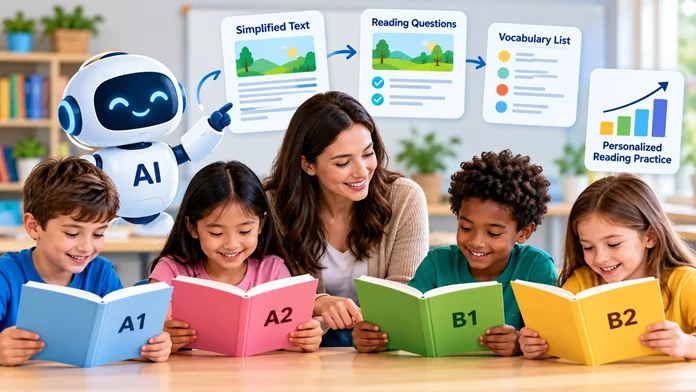
Ask an English teacher what they would do with an extra hour a day, and you will hear about sleep, marking, and lunch, in roughly that order. Ask what they would do with an extra hour of preparation time, though, and the answer changes. A lot of them would finally give each student something to read at the right level, the thing they know works and never have time for. AI to personalize reading practice offers English teachers a practical way to tailor reading materials to different student needs.
However, its effectiveness depends on how the technology is used, and several important limitations deserve closer attention. So this is a more practical look at what AI can genuinely do for reading practice in an English classroom, what it does badly, and where the teacher still has to be the one making the call.
It’s written for teachers of English as a second or foreign language with mixed-level classes, which, in our experience working with schools, is nearly all of them.
Why Personalized Reading Practice Is So Hard Without Help
English teachers often manage 20–35 students with four to six different reading levels in one classroom.
The textbook has one text per unit. That text is comfortable for maybe a third of the room, too easy for a few, and quietly too hard for the rest. The quietly-too-hard group is the one that worries us most, because their difficulty is easy to misread.
A student who meets eight unknown words on the first page doesn’t usually say so. They go slow, they go silent, and after a few weeks they get described as a reluctant reader, when what actually happened is that the text sat just above the point where reading turns into translation. Nobody does translation for pleasure.
The honest fix a different text for each level, every week has always been impossible on time alone. If preparing one properly levelled text with questions takes forty minutes, four levels is nearly three hours per unit. Teachers have known this for decades. They simply haven’t had a tool that could absorb the volume.
That is the gap AI actually fills. Not the judgment, which we’ll come back to, but the volume.
6 Ways AI Can Help English Teachers Personalize Reading
The examples below feature popular AI assistants, including ChatGPT, Claude, and Gemini. The focus is on practical classroom applications rather than specific tools. We’ve deliberately avoided recommending a specific one, because the differences between them matter far less than how you use them.
1. Rewriting one text at three or four difficulty levels
This is the use that saves the most time, and it’s the one teachers adopt first. You paste in the unit text and ask for a version at A1, A2, and B1, keeping the same story and the same key vocabulary. Thirty seconds later, you have the three versions you could never have written on a Tuesday evening.
AI tends to confuse “simpler” with “shorter”. It will often cut the text in half, keep the idioms, and present you with something that is briefer but not actually easier. The fix is to ask explicitly for shorter sentences, high-frequency vocabulary, and no idioms, and then to read the result yourself before any student does. Which brings us to step 4 in the image above, and we’ll keep coming back to it.
2. Generating comprehension questions at different depths
Writing good questions is slower than most people outside teaching realise, and AI is genuinely good at the first draft. Ask for three literal questions, three inferential ones, and one that needs a personal response, and you’ll usually get something usable.
What it tends to do, left to itself, is produce five variations of “What is the main idea of the text?” If you’ve seen that question once, you’ve seen it enough. Give it the depth structure you want, and ask for questions that can’t be answered by copying a sentence from the text.
3. Building a pre-teaching vocabulary list from any text
Before a class reads something, it helps to pull out the six to ten words most likely to block understanding and teach them first. AI does this reliably from a pasted text, and it will add simple definitions and example sentences if you ask.
4. Giving students a reading partner who never gets tired
Some teachers set up a simple chat where a student can ask questions about a book they are reading, in English, and get an answer at their level. For a shy student who would never raise a hand in class, this can be the first time they’ve asked a question about a text at all.
Two warnings. First, the model will confidently invent plot details if it doesn’t have the text in front of it, so the text needs to be pasted in or the activity falls apart. Second, this works far better with students who already read reasonably well. For a true beginner, a chat window is one more thing to decode.
5. Turning reading data into actual decisions
This is the step most articles skip, and it’s the one that makes the others worth doing.
Personalization has to start with knowing where each student actually is, and AI can’t tell you that from nothing. You need a reading level for each student and some record of what they’ve read and where they stalled. That data has to come from somewhere real: a placement test, a reading log, a platform that tracks it.
In our case, that platform is BOOKR Class, a levelled library of narrated storybooks for English learners with a built-in Lexile placement test and a Teacher’s Dashboard showing who read what and where comprehension dropped. We should be clear that it isn’t an AI tool itself – it’s where the reading data comes from.
Once you have that data, though, an AI assistant becomes far more useful: paste in the class summary and ask which students are reading well below their level, which ones haven’t opened a book in two weeks, and how you might group them for next week.
6. Using AI to Write Parent Communication Notes
Not glamorous, but real. A short note home explaining that a child is reading at a certain level, what the next step looks like, and what a parent could do in fifteen minutes in the evening is exactly the kind of writing that gets postponed for a month.
Where AI Gets Reading Practice Wrong
It’s worth being upfront about the limits, because the failures are specific and predictable.
It flattens texts. A simplified version is often technically readable and completely dull, with all the rhythm removed. Students notice. A graded reader written by a human author for that level is, in our experience, usually better than an AI-simplified version of a harder text, and we’d rather say that than pretend otherwise.
It can’t do sound. Text-based AI gives you words on a screen. For English learners – especially younger ones – pronunciation and listening are half the job, and a word met only in print gets pronounced by guesswork. This is the reason every book in the BOOKR Class library is narrated, and it’s a reason to be cautious about any reading routine that is entirely text and screen.
It misses cultural references. Models sometimes keep an idiom or a reference that means nothing to a learner in Brazil or Vietnam, because it reads as “simple English” to the model. You’ll catch it. The model won’t.
And we genuinely don’t know yet whether AI-adapted texts teach as well as human-graded ones. There isn’t good research on it. It seems plausible that they do for the purposes of practice volume, and less plausible for texts that are supposed to be enjoyed. Until there’s evidence, we’d use AI-adapted texts for practice and keep real books for reading.
Keeping the Personal Touch
The worry teachers raise most often is that personalization by machine will make the teaching less personal. We think the opposite is closer to true, with one condition. Every text, every question set, every parent note gets read by a person who knows the student before it reaches them. If that step is skipped, you have a very efficient way of sending thirty students thirty slightly wrong things. If it’s kept, the teacher has spent her time on the part only she can do.
In Summary
- Most English classes contain four to six reading levels, and the textbook serves one of them.
- AI’s genuine contribution to personalized reading practice is volume: levelled versions, question sets, vocabulary lists, parent notes.
- Its reliable failures are flattening texts, confusing shorter with simpler, missing cultural references, and having no audio.
- Personalization needs real reading data first: a placement test, a reading log, or a platform that tracks it.
- Human-written graded readers are still usually better than AI-simplified texts for actual reading, as opposed to practice.
- The teacher reads everything before the student does. That step is not optional.
FAQs on Using AI to Personalize Reading Practice
Q: Do I need a paid AI tool to personalize reading practice?
Ans:
No. The free tiers of the major assistants handle all six uses above. What you need more than a paid tool is a clear sense of each student’s level, which is a data question rather than an AI question.
Q: Will students be able to tell a text was adapted by AI?
Ans:
Yes, adapted texts tend to be flatter and less rhythmic. For practice material, that’s usually acceptable.
Q: How do I find each student’s reading level in the first place?
Ans:
A placement test that produces a reading level, such as a Lexile measure, is the most direct way. Some reading platforms include one. A simpler alternative is the ninety-five percent rule: if a student knows fewer than roughly ninety-five words in a hundred on a page, the text is too hard.
Q: Is it safe to put student data into an AI tool?
Ans:
Check your school’s policy before pasting anything that identifies a student. Many teachers use initials or anonymised summaries, which work just as well for the pattern-spotting described above and avoid the question entirely.
 Hobbies That Start With D | Fun Hobbies Word List
 Hobbies That Start With C | Fun Hobbies Word List
 Hobbies That Start With B | Fun Hobbies Word List