
A Complete Guide to Mastering English Pronouns with Pronoun Examples
Home » Parts of Speech » A Complete Guide to Mastering English Pronouns with Pronoun Examples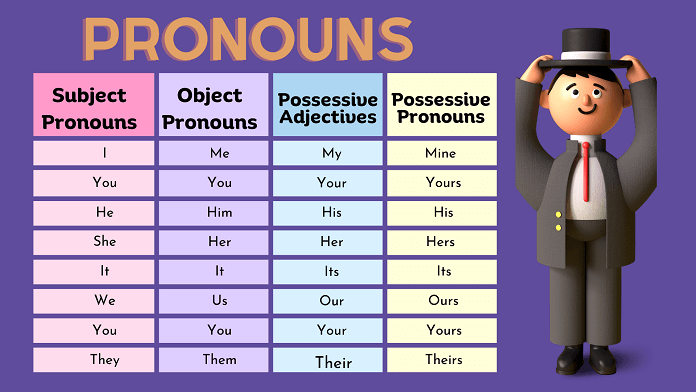
One of English grammar’s key components is the pronoun. This is something that you will encounter frequently in language studies. Pronouns are crucial to understanding what a pronoun is. Its usage and its placement within a sentence.
Accurate pronoun usage is essential for clear communication, facilitating comprehension of relationships between sentence elements. Mastery involves knowledge of pronoun functions, forms, and grammatical rules, enhancing language precision.
This article will take you into pronouns, exploring their functionality and purpose, complemented by examples for a comprehensive grasp of their role.
English Pronouns | What Are Pronouns? | Definition & Examples
What Are Pronouns?
Pronouns are words or phrases that serve as substitutes for nouns or noun phrases and help keep our writing varied. It limits unnecessary repetition when the audience knows the referred noun. For instance, saying, “I have a doll. She’s black and white,” eliminates redundancy by using the pronoun “she” to reference the previously mentioned doll.
One of the nine parts of speech in English is the pronoun. They play a vital role in maintaining variety in writing by allowing for more concise and fluid expression and avoiding repetitive use of specific nouns.
- John went to the supermarket to buy shoes. He picked up a black one to go with her jacket.
Using alternative names may create confusion, leading the reader to perceive distinct entities. Thus, pronouns serve the purpose of substituting nouns for clarity and coherence.
There are various pronoun types in English, each designed for specific functions. Common pronouns include personal pronouns (e.g., he, she, they), possessive pronouns (such as his, her, their), reflexive pronouns (e.g., himself, herself), and relative pronouns (who, which, that).
These various pronoun types are crucial in organizing sentences and facilitating the articulate and succinct conveyance of ideas.
Pronoun Cases
In the English language, pronouns are essential parts of speech that are used to replace nouns to avoid repetition and maintain clarity. Pronouns have different forms based on their function in a sentence, called cases. There are three prominent cases of pronouns: subject, object, and possessive.
Subject Pronouns
Subject pronouns serve as the subject of a sentence or clause. It is a substitute for nouns and indicates the entity performing the verb’s action. Examples of subject pronouns include:
- I
- You
- He
- She
- It
- We
- They
Example Sentence of subject pronouns in use:
| Noun | Subject Pronoun | Example Sentence |
|---|---|---|
| Mary | She | Mary went to the store. |
| Dogs | They | Dogs bark loudly at night. |
| Book | It | The book is on the shelf. |
Object Pronouns
Object pronouns serve as objects of a verb or a preposition. It conveys information about the recipient of an action or the target of the action. Examples of object pronouns include:
- Me
- You
- Him
- Her
- It
- Us
- Them
Examples to illustrate the use of object pronouns in sentences:
- John gave the book to Mary.
- She trained the dogs and rewarded them.
- Please pass the book; I need to read it.
Possessive Pronouns
Possessive pronouns signify ownership or possession. It clarifies the relationship between the owner and the object. Examples of possessive pronouns include:
- Mine
- Yours
- His
- Hers
- Its
- Ours
- Theirs
Here are examples to explain the use of possessive pronouns in sentences:
- The car is Mary’s, and this is her book.
- The dogs found their way home.
- The company is known for its innovation.
Pronouns: Person and Number
First Person:
- Singular Subject: “I” refers to oneself as the subject.
- Singular Object: “Me” is utilized when the speaker is the object of the action.
- Plural Subject: “We” denotes a group including the speaker as the subject.
- Plural Object: “Us” is used when the group, including the speaker, is the object.
Example Sentences of First Pronouns
| Pronoun | Type | Example Sentence |
|---|---|---|
| I | Singular Subject | I am going to the store. |
| Me | Singular Object | She gave the book to me. |
| We | Plural Subject | We are planning a trip. |
| Us | Plural Object | They invited us to the party. |
Second Person:
- Singular and Plural Subject/Object: “You” addresses the listener(s) directly. Context helps determine whether it’s singular or plural.
Examples of sentences for second-person pronouns
- Singular Subject: You should call your friend.
- Singular Object: I wish to give this to you.
- Plural Subject: All of you must complete your tasks.
- Plural Object: Our doctor praised you for the research.
Third Person:
The third-person pronouns in English pertain to individuals or entities beyond the speaker or listener. These pronouns are differentiated into singular and plural forms, with a gender-based distinction in the singular category.
| Type | Subject Pronoun | Object Pronoun |
|---|---|---|
| Singular (Male) | He | Him |
| Singular (Female) | She | Her |
| Singular (Neutral) | It | It |
| Plural | They | Them |
Third Person Example Sentences
| Sentence | Pronoun Used |
|---|---|
| Singular (Male): He is going to the store. | He |
| Singular (Female): She gave her a gift. | She, Her |
| Singular (Neutral): It is raining outside. | It |
| Plural: They are waiting for their turn. | They, Them |
These differences in first, second, and third-person pronouns help convey precise information about the perspective and participants in a conversation.
Pronoun and Antecedent
An antecedent is a noun or noun phrase that provides context for a pronoun, helping readers to determine the reference. It can encompass various nouns, such as a garden hose, a shed, or any other relevant noun.
In the examples below, the antecedents are italicized, while the pronouns are in bold:
- Jackson decided that he would go down to visit her grandfather.
- The sun grinned as it gracefully slipped beneath the clouds.
While an antecedent is not always explicitly required, a clear context obviates the necessity. Pronouns like I, me, and you can be easily understood when the speaker is known.
While technically possible, placing a pronoun before an antecedent is generally avoided to prevent confusion among readers.
Example:
- It makes me happy! My beautiful yellow jacket brings me joy.
Different Types of Pronouns with Examples
Personal Pronoun With Examples
Personal pronouns substitute for nouns, denoting individuals or objects. They are categorized into subject pronouns and object pronouns.
Subject Pronouns:
- I presented the proposal.
- She completed the assignment.
Object Pronouns:
- He introduced me to his friend.
- We discussed the plan with them.
Possessive Pronoun with Examples
Possessive pronouns indicate ownership and replace noun phrases to convey possession. Common possessive pronouns include:
- Mine: This book is mine.
- Yours: The decision is yours.
Demonstrative Pronoun with Examples
Demonstrative pronouns indicate specific entities and replace nouns. Typically, it indicates objects in proximity or at a distance. Common demonstrative pronouns include:
- This: This is my laptop.
- That: I want that book on the shelf.
- These: These are the shoes I bought yesterday.
- Those: I don’t like those paintings.
Interrogative Pronounwith Examples
Interrogative pronouns facilitate formulating questions seeking information about a person or thing. Common interrogative pronouns include:
- Who: Who did the dishes?
- Whom: To whom did you speak?
- Which: Which book is your favorite?
- What: What is the purpose of this meeting?
Relative Pronoun with Examples
Relative pronouns introduce clauses that give extra information about a noun or pronoun. Common relative pronouns include:
- Who: The woman who lives next door is friendly.
- Whom: The student whom the teacher praised is talented.
- Whose: The car, whose color is red, belongs to John.
- Which: The book, which is on the shelf, is fascinating.
- That: The movie that we watched last night was captivating.
Reflexive Pronoun with Examples
Reflexive pronouns emphasize actions performed by the subject toward itself. Common reflexive pronouns include:
- Myself: I cut myself while cooking.
- Yourself: Please help yourself to some snacks.
- Himself: She trained himself to play the guitar.
- Herself: She dressed herself for the party.
- Itself: The cat groomed itself.
- Ourselves: We organized the event ourselves.
- Yourselves: You can decide for yourselves.
- Themselves: They completed the project themselves.
Indefinite Pronoun with Examples
Indefinite pronouns refer to nonspecific people or things. Common indefinite pronouns include:
- Someone: Someone left their umbrella.
- Anyone: Anyone can join the club.
- Everyone: Everyone needs a break.
- No one: No one arrived on time.
- Few: Few attended the meeting.
- Several: Several expressed interest.
- Any: Have any of you seen my keys?
- Each: Each has a unique perspective.
- Either: You can choose either option.
- Somebody: Somebody called for you.
- Everybody: Everybody enjoyed the concert.
- Nothing: There’s nothing in the box.
Reciprocal Pronoun Examples
Reciprocal pronouns signify a mutual relationship between subjects. Common reciprocal pronouns include:
- Each other: They helped each other with the project.
- One another: The students shared their ideas with one another.
Intensive Pronoun with Examples
Intensive pronouns emphasize the subject by restating it and are formed by adding -self or -selves to personal pronouns. Common intensive pronouns include:
- Myself: I myself did the dishes.
- Yourself: You should decide for yourself.
- Himself: He himself made the decision.
- Herself: She herself completed the task.
- Itself: The machine fixed itself.
- Ourselves: We will handle it ourselves.
- Yourselves: You can enjoy it yourselves.
- Themselves: They managed it themselves.
Gender Pronouns Examples
Common Examples of Gender Pronouns
Gender pronouns operate within a binary framework: male or female. In the 3rd person singular, he/him/his or she/her/hers indicates gender identity. They replace names, serving as references to individuals.
- He/Him/His: John said he would join us later. I saw him at the park.
- She/Her/Hers: Mary mentioned she is coming. He will meet her at the cafe.
- They/Them/Theirs: Alex prefers they/them pronouns. I invited them to the event.
- Ze/Zir/Zirs: Jordan uses ze/zir pronouns. I spoke with zir yesterday.
- Xe/Xem/Xyrs: Taylor’s pronouns are xe/xem/xyrs. Xe will present at the conference.
Gender-Neutral Pronoun Examples
Gender-neutral pronouns refer to people in a way that does not specify their gender.
- They/Them/Theirs: Alex mentioned they will join the meeting. I appreciate their input.
- Ze/Zir/Zirs: Jordan prefers ze/zir pronouns. I collaborated with zir on the project.
- Xe/Xem/Xyrs: Taylor’s pronouns are xe/xem/xyrs. I reached out to xe for assistance.
Pronoun-Antecedent Agreement
The pronoun-antecedent agreement is required for clear writing. It ensures alignment in number, person, and gender between a pronoun and its antecedent, the earlier-mentioned noun or noun phrase in the text. Adhering to rules and examples is essential for precision.
Singular and Plural Agreement
The singular and plural agreement maintains harmony between subjects and verbs. Singular subjects require singular verbs, and plural subjects necessitate plural verbs for grammatical accuracy.
Correct Examples:
- The dog barks every morning. (singular subject and singular verb)
- Both sisters run marathons. (plural subject and plural verb)
Incorrect Examples:
- The cat on the roof run away. (singular subject with incorrect plural verb)
- My collection of stamps is valuable. (plural subject with incorrect singular verb)
Pronoun Agreement with Indefinite Antecedents
Pronoun agreement with indefinite antecedents ensures that pronouns match in number with vague or nonspecific nouns, such as someone, anyone, everyone, no one, and others.
Correct Examples:
- Someone left their umbrella. (singular indefinite antecedent with a gender-neutral pronoun)
- Everybody needs a break. (singular indefinite antecedent with singular pronoun)
Incorrect Examples:
- Someone left his umbrella. (gender-specific pronoun with indefinite antecedent)
- None were willing to share his opinion. (singular pronoun with plural indefinite antecedent)
Third-person Pronoun Usage
Third-person pronoun usage involves the application of pronouns, such as he, she, it, they, and others. It refers to individuals or objects outside the conversation between the speaker and the listener.
Correct Examples:
- He is coming to the meeting.
- The cat is sleeping; it looks comfortable.
- The team submitted their reports.
Incorrect Examples:
- The team submitted his reports.
- She will need to fix its schedule.
Pronoun Usage
In this section, we will explore the usage of pronouns in English, explicitly examining their functions as direct and indirect objects, expletives, and distributive pronouns.
Direct and Indirect Objects
She gave him a gift.
- Direct Object: Gift
- Indirect Object: Him
They assisted us.
- Direct Object: Assistance
- Indirect Object: Us
I bought her flowers.
- Direct Object: Flowers
- Indirect Object: Her
He showed them the way.
- Direct Object: Way
- Indirect Object: Them
Expletives
Expletive Pronouns:
Introduce sentences without referencing specific nouns; “it” is commonly a placeholder for the subject.
- Example: It is important that we understand pronouns.
Distributive Pronouns:
Include each, every, either, neither; refer to individual elements within a group or pair without specifying.
- Example: Each trainee must submit their work by Friday.
Improving Communication:
Understanding pronoun roles as direct and indirect objects, expletives, and distributive pronouns enhances English writing and communication.
Pronouns in Noun Phrases
Noun Phrase Structure: Comprises a head (noun or pronoun) and dependent words, providing specific information before or after the head.
Dependent Words: Modify and give details about the head within a noun phrase.
Pronouns in Noun Phrases: Function as substitutes for nouns or noun phrases, with their referents either named or implied based on the context.
Examples of pronouns found in noun phrases can take various forms, such as:
Personal Pronouns
- Example: He, She, They
- Function in Noun Phrase: Serve as substitutes for specific individuals.
Possessive Pronouns
- Example: His, Her, Theirs
- Function in Noun Phrase: Indicate ownership or possession.
Demonstrative Pronouns
- Example: This, That, These
- Function in Noun Phrase: Point to specific entities in space or time.
Interrogative Pronouns
- Example: Who, Whom, Which
- Function in Noun Phrase: Introduce questions, seeking information.
Relative Pronouns
- Example: Who, Whom, Whose
- Function in Noun Phrase: Connect relative clauses, providing additional information.
Indefinite Pronouns
- Example: Someone, Anyone, None
- Function in Noun Phrase: Refer to nonspecific individuals.
Examples of pronoun usage in noun phrases:
1. Personal Pronouns:
- Example: She bought a new car.
2. Possessive Pronouns:
- Example: The book is mine.
3. Demonstrative Pronouns:
- Example: These are the flowers I bought.
4. Interrogative Pronouns:
- Example: Which movie did you watch?
5. Relative Pronouns:
- Example: The person who called needs a response.
6. Indefinite Pronouns:
- Example: Someone left their umbrella.
Additional Modifiers in Noun Phrases with Pronouns:
- Determiners: This project won the contest.
- Quantifiers: Many of them have arrived.
- Numbers: Several of us went hiking.
- Adjectives: The rustic house brings back memories.
Pronouns are integral to noun phrases, substituting for nouns, improving language conciseness and preventing redundancy. Appreciating the various roles of pronouns within noun phrases contributes to improved communication and comprehension skills for readers and writers alike.
Pronouns in Parts of Speech
Pronouns are a crucial facet of English speech. They contribute to writing and speech by introducing variety and conciseness. As a subset of nouns, they play a pivotal role in maintaining coherence by replacing repetitive elements.
Personal Pronouns
- Examples: I, you, he, she, it, we, they
- Function: Represent people or things; can be subjective or objective
Demonstrative Pronouns
- Examples: these, those, this, that
- Function: Identify and specify particular persons or things
Interrogative Pronouns
- Examples: who, whom, which, what
- Function: Introduce questions
Relative Pronouns
- Examples: who, whom, whose, which, that
- Function: Introduce relative clauses, linking them to the main clause
Indefinite Pronouns
- Examples: all, another, any, anybody, anyone, anything, both, each, either, everybody, everyone, everything, few, many, neither, nobody, none, no one, nothing, one, other, several, some, somebody, someone
- Function: Refer to nonspecific persons or things
Reflexive Pronouns
- Examples: myself, yourself, himself, herself, itself, ourselves, yourselves, themselves
- Function: Indicate that a person or thing is acting on or toward itself
Intensive Pronouns
- Examples: myself, yourself, himself, herself, itself, ourselves, yourselves, themselves
- Function: Used for emphasis; same form as reflexive pronouns
Pronouns List
Here is a list of common pronouns for more understanding and the main categories to which they belong.
- Reflexive Pronouns
Examples: himself, herself, myself, yourself, itself, ourselves, yourselves, themselves
- Personal Pronouns
Subjective Examples: he, she, I, you, they
Objective Examples: me, you, her, him, it, them, us
- Possessive Pronouns
Examples: mine, yours, its, ours, theirs, hers, his
- Relative Pronouns
Examples: whom, that, who, which
- Indefinite Pronouns
E.g.: all, any, anybody, everybody, everyone, another
- Demonstrative Pronouns
Examples: this, that, these, those
- Interrogative Pronouns
Examples: who, what, which
- Intensive Pronouns
E.g.: himself, herself, itself, myself, yourself, ourselves, yourselves, themselves
Common Pronoun Mistakes
Unclear Antecedents:
- Mistake: Mary gave a gift to Jane, and she loved it.
- Correction: Mary gave a gift to Jane, and Jane loved it.
Mismatched Pronoun and Antecedent:
- Mistake: The team, along with the coach, are doing their best.
- Correction: The team, along with the coach, is doing its best.
Subject/Object Confusion:
- Mistake: John and me are attending the conference.
- Correction: John and I are attending the conference.
Ambiguous Pronoun Reference:
- Mistake: Lisa told Emily that she passed the exam.
- Correction: Lisa told Emily that Lisa passed the exam.
Inconsistent Pronoun Usage:
- Mistake: He is a friend of Sarah, but they don’t understand her.
- Correction: He is a friend of Sarah, but he doesn’t understand her.
 List of Nouns That Start With A in English
 How Quality Print and Design Shape Powerful Business Cards
 List of Ice Cream Flavors | A-Z Vocabulary Word List